
Whether you're a small business owner packaging handmade goods or a warehouse manager shipping thousands of units a week, choosing the right poly bag makes a bigger difference than most people realize. The wrong bag can lead to damaged products, wasted material, and unhappy customers. The right one keeps your products protected, your costs down, and your operation running smoothly.
Here's what to consider when selecting a poly bag for your business.
1. Know Your Product Dimensions
The first and most important step is measuring your product accurately. A poly bag should be large enough to fit the item comfortably — typically with 1–2 inches of extra space on each side and enough length to seal properly. Too tight and you risk splitting the bag; too loose and the extra material becomes a waste of money.
For irregularly shaped products, measure the widest and longest points and add your buffer from there. Our Bag Size Calculator can help you find the right fit quickly.
2. Understand Bag Types
There are several common poly bag styles, each suited to different applications:
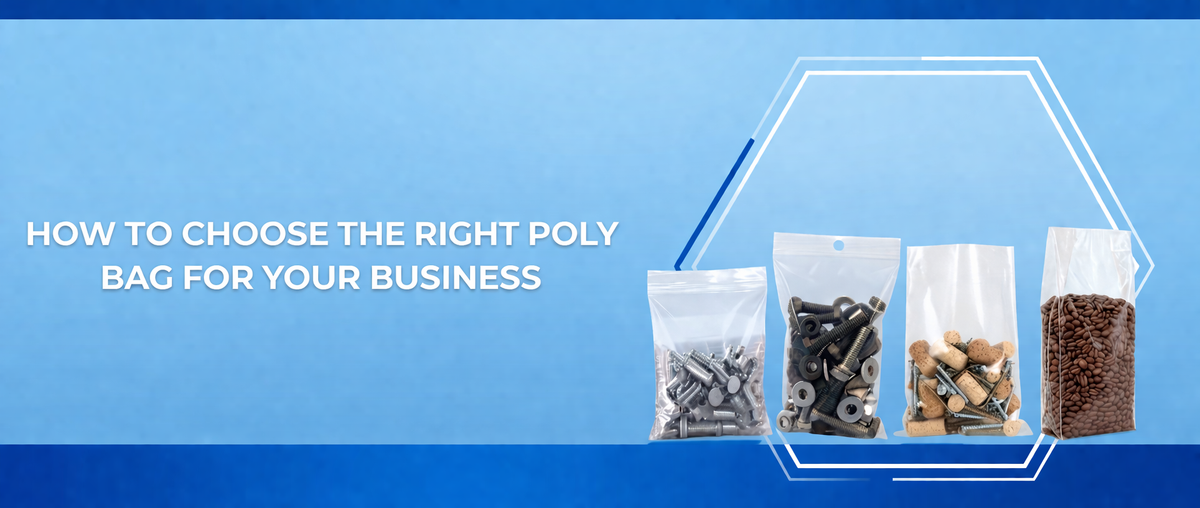
· Flat poly bags are the simplest and most economical. They work well for lightweight items like clothing, documents, and small parts that don't require a resealable closure.
· Reclosable ziplock bags are ideal when customers or end users need to open and close the bag multiple times — perfect for food items, hardware, or retail products.
· Gusseted poly bags have expandable sides and bottoms, making them better suited for bulky or irregularly shaped items.
· Adhesive tape bags (suffocation warning bags) are required by many retailers and platforms like Amazon for any bag with an opening larger than 5 inches. These bags are printed with a standard safety warning and help businesses stay compliant.
3. Consider the Mil Thickness
Mil refers to the thickness of the plastic, with one mil equaling one-thousandth of an inch. Thicker bags offer more puncture resistance and durability, while thinner bags are lighter and more cost-effective for lightweight items. We go deeper on this topic in a separate guide, but as a general rule: lightweight apparel does fine in 1.5–2 mil bags, while heavier industrial parts benefit from 4 mil and above.
4. Think About Your End Use
Are your bags going directly to consumers as retail packaging? Will they sit in a warehouse for months? Are food safety regulations a concern? Each scenario changes what you need:
· Retail packaging often benefits from clear, high-clarity bags that show off the product. Our polypropylene bags offer exceptional clarity for display purposes.
· Long-term storage may call for thicker, more durable options like our 6 mil flat poly bags.
· Food contact applications require bags made from 100% virgin resin to meet FDA and USDA compliance standards — browse our food bags collection for compliant options.
5. Order a Sample Before You Commit
One of the best ways to make a confident decision is to request a free sample before placing a bulk order. At Elements Supply, we offer free samples on most of our products so you can feel the material, test the fit, and confirm it's the right choice before committing.
Choosing the right poly bag doesn't have to be complicated. If you're still unsure, our team is available Monday through Friday, 8am–5pm PST, to help you find the perfect match for your application — at no extra cost. You can also submit a Custom Quote Request for larger or specialized orders.