Auto bags on roll are pre-opened poly bags connected by perforations on a continuous roll, allowing users or machines to open, fill and tear off one bag after another. Choosing the right bags requires three considerations: a bag size that fits your product with room to seal, a gauge (mil thickness) that matches how heavy or sharp the product is, and a roll that fits your bagger or dispenser. This guide walks through each one using the available sizes and gauges.
What auto bags on roll are and who uses them
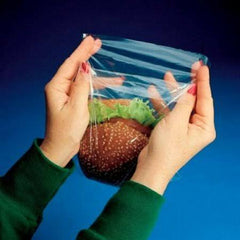
Each bag is sealed on the bottom and open on the top, and the open side is already separated so the bag puffs open when air hits it. The bags are joined by a perforation line, so the next bag is always in position. On an automatic bagger, the machine blows the bag open, the product is loaded, and the machine seals it and tears it off. Without a machine, you can run them off a simple roll dispenser and seal with a heat sealer or tape.
They make the most sense for anyone packing the same item over and over: hardware kits, small parts, candy and snacks, bakery items, printed inserts, medical and lab supplies, and e-commerce orders where one SKU ships a lot. For businesses that hand-load loose flat bags throughout the day, auto bags are usually the first step up in speed, even before you buy a machine.
How to size auto bags on roll
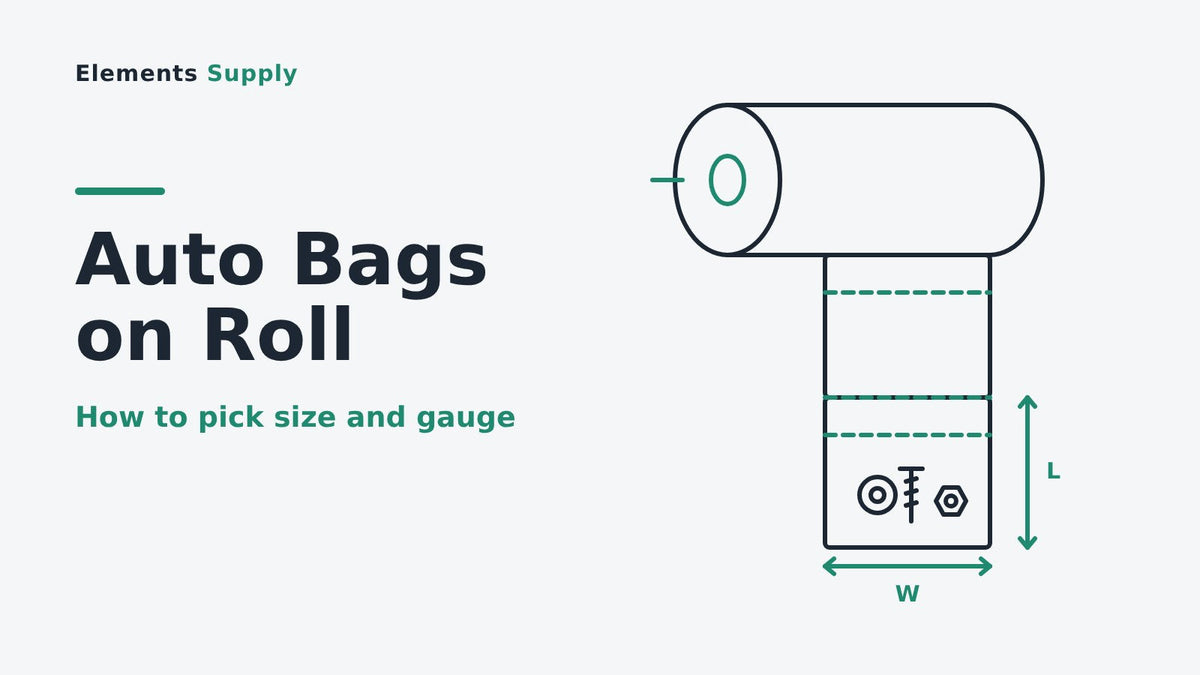
Auto bag sizes are listed width by length. Width is the opening, measured across the roll. Length runs from the opening down to the sealed bottom. The most common mistake is ordering a bag that matches the product exactly. A bag that fits a flat object on paper gets tight fast once the product has any thickness, and the machine needs some film above the product to make a clean seal.
A simple sizing rule
- Width: product width plus product thickness, plus about 1/2" to 1" so it drops in without catching.
- Length: product length plus product thickness, plus about 1" to 1 1/2" of headspace for the seal.
Example: a parts kit that measures 3" x 5" and is 1" thick works out to roughly a 4.5" x 7" bag, so a 5" x 7" or a 5" x 8" bag is the right call. When choosing between two sizes, the longer option is generally recommended. A little extra length costs almost nothing, and a bag that is too short causes bad seals and jams. Before placing a full-case order, test with a few products or a sample roll.
Choosing the right gauge
Auto bags are available in four gauges. Thicker film holds up better against weight, corners and abrasion, but you get fewer bags per roll and you pay more per bag. Pick the thinnest one that does the job. For more information on how mil thickness works, our poly bag thickness guide covers it.
| Gauge | Mil | Good for | Sizes we stock |
|---|---|---|---|
| Standard | 1.4 mil | Light items: candy, cookies, printed inserts, soft goods, small plastic parts | 2" x 3" up to 10" x 15" |
| Medium | 1.9 mil | General fulfillment, kits with some weight, items with mild corners | 3" x 6" up to 9" x 12.5", plus a 6" x 8" with white back |
| Heavy | 2.75 mil | Hardware, screws and fasteners, metal parts, heavier bundles | 2" x 3" up to 10" x 15" |
| Extra heavy | 3.7 mil | Sharp, heavy or abrasive contents where a puncture is not an option | 4" x 6" |
A few practical notes:
- If the product has a point or threaded edge (bolts, drill bits, metal brackets), skip standard and start at heavy. A bag that pokes through in a shipping box is a return.
- For food, weight usually matters less than appearance and seal quality. Standard or medium gauge covers most bakery and snack items. Elements Supply auto bags are made from polyethylene and listed as FDA and USDA compliant for direct food contact. Our FDA and USDA packaging guide explains what that means for your products.
- The white back medium gauge bag gives a solid background behind the product, which makes small items stand out and hides whatever is behind the bag on a peg or shelf.
Bags per roll: what you actually get
Roll counts change with both size and gauge. Bigger and thicker bags mean fewer bags on the roll, which means more roll changes on the line. Here is how one common size compares across our gauges:
| 4" x 6" auto bags | Bags per roll |
|---|---|
| 1.4 mil standard | 2,500 |
| 1.9 mil medium | 2,000 |
| 2.75 mil heavy | 1,250 |
| 3.7 mil extra heavy | 1,000 |
When you compare prices, compare cost per bag, not cost per roll. A cheaper roll with half the count is not cheaper. And if you run a lot of volume, fewer roll changes is real labor saved, which is one more reason not to go heavier than you need.
Making sure the roll fits your machine or dispenser
A lot of auto bag headaches are fit problems, not bag problems. Check these before you order:
- Core size. Our auto bags come on a convertible core that fits 1" to 3" spindles, which covers most baggers and dispensers without changes.
- Bag width range. Every machine has a minimum and maximum bag width it can open and seal. Check your manual or the label on the machine and make sure your bag width falls inside it.
- Roll diameter. Heavier gauge and longer bags make a bigger roll. If your machine has a tight roll cradle, confirm the maximum roll diameter it takes.
- Seal settings. If you move from 1.4 mil to 2.75 mil, expect to adjust seal heat or dwell time. Run a few bags and pull on the seal before you start a full run.
For businesses without an automatic bagging machine, auto bags still work. Hang the roll on a dispenser or a rod, tear off a bag, load it and seal it with an impulse heat sealer or close it with tape. It is slower than a bagger but faster than opening loose flat bags one at a time.
Auto bags vs loose bags and other options
Auto bags make sense when you pack the same size product in volume. If your products change size from order to order, loose flat poly bags in a few sizes may be simpler. If the customer needs to open and close the bag again, like a parts kit that gets used over time, look at ziplock bags instead. And if you are packing for Amazon, read our post on suffocation warning bags for FBA before you settle on a bag, since warning requirements depend on the bag opening size.
FAQ
Are auto bags on roll the same as pre-opened bags on roll?
Yes. You will see them called auto bags, auto-fill bags, pre-opened bags on roll and bags on a roll. They all mean a roll of perforated poly bags with a sealed bottom and an opening that is already separated.
Can I use auto bags without an automatic bagging machine?
Yes. You can run them by hand from a dispenser and seal with an impulse heat sealer or tape. You still save time over loose bags because each bag is ready to open.
What size auto bag do I need?
Add the product thickness to both the width and length, then add about 1/2" to 1" to the width and 1" to 1 1/2" to the length for loading and sealing. When in doubt, go one size longer.
What mil thickness is best for auto bags?
Use 1.4 mil for light items, 1.9 mil for general fulfillment, 2.75 mil for hardware and heavier parts, and 3.7 mil for sharp or abrasive contents.
Will these bags fit my machine?
Elements Supply auto bags are on a convertible 1" to 3" core that fits most baggers and dispensers. Check that your bag width is within your machine's range and that the roll diameter fits the cradle.
Ready to set up your line? Shop all sizes and gauges in our pre-opened auto bags on roll collection.